What is the codling moth and how can you recognize it?
The codling moth (Cydia pomonella) is a small, rather inconspicuous moth. It lays its eggs on leaves and young fruit. The hatched caterpillar bores into the fruit, leaving behind tunnels, holes, and crumbly excrement. Infestation often only becomes noticeable due to partially eaten fruit or apples that fall from the tree prematurely. In addition to apples, the codling moth also attacks pears, both in home gardens and in orchards.
Where does the codling moth come from and what does a codling moth trap show?
The moths fly during the warm season; egg-laying begins around mid-May and continues over several weeks. Once the caterpillar is fully grown, it leaves the fruit and looks for a hiding place to overwinter, often in the soil under the tree. The next year, new moths emerge from these. You can observe whether moths are currently active in your tree using a codling moth trap that uses pheromones to attract them. Although a codling moth trap catches adult moths, it does not eliminate the infestation in the fruit. Therefore, anyone wanting to control codling moths should focus on two points: the eggs in the tree and the larvae in the soil.
Controlling codling moths: Which remedy really works against codling moths?
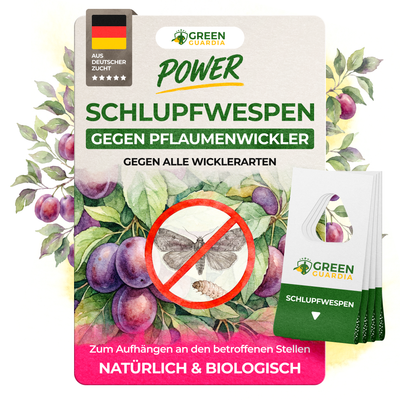
There is a suitable biological remedy for codling moths for both areas. Starting around mid-May, Schlupfwespen against codling moths take care of the eggs. These tiny beneficial insects of the Trichogramma genus hatch from carrier cards that you hang in the tree starting around mid-May. They parasitize the codling moth eggs before a caterpillar can develop. Since egg-laying continues over several weeks, a single application is not enough. Our parasitic wasps therefore arrive as a 9-week treatment in three shipments, with three cards per tree.
In late summer and after the fruit has fallen, you use SF-Nematoden against codling moths to deal with the larvae in the soil. You apply them by watering the root area of the tree when soil temperatures are between 10 and 28 °C. Afterward, keep the soil moist for two weeks. This allows you to control the codling moth before it pupates and flies off the following year. Additionally, collect infested fruit and fallen fruit and dispose of them in the household waste rather than the compost. Because our range is organized by target pest, you can find both remedies for codling moths here in one place, completely without the need for chemical sprays on the tree.