

















































Identifying tobacco whiteflies and combating them with Eretmocerus parasitic wasps
The tobacco whitefly, also known as the sweetpotato whitefly, can weaken vegetable and ornamental plants through its feeding activity. Our Eretmocerus parasitic wasps are natural antagonists of their larvae. Here you will learn why they are a good match for Bemisia tabaci and how to prepare for their use.
What is the tobacco whitefly?
The tobacco whitefly belongs to the whiteflies (Aleyrodidae). Despite its name, it infests more than just tobacco plants. Adult insects are tiny and have whitish, powdery wings.
Distinguishing it from the greenhouse whitefly is difficult for amateurs. If findings are unclear, magnified photos or expert identification can help.
Typical signs of an infestation
- Small white insects fly up when touched.
- Flat larvae sit on the undersides of leaves.
- Leaves and areas underneath become sticky.
- New findings appear on neighboring plants.
What damage does the tobacco whitefly cause?
The insects suck plant sap and excrete honeydew. Sooty mold fungi can colonize the sticky coating. In case of heavy infestation, growth and plant quality suffer.
Which plants should you check?
Inspect vegetable and ornamental plants in the greenhouse, conservatory, and indoors. Inconspicuous neighboring plants should also be included in the check so that early centers of infestation are not overlooked.
Where does the tobacco whitefly develop?
Eggs and immature stages are located on the leaves. After a mobile first larval stage, the subsequent stages remain mostly stationary.
Therefore, treatment must target the plant itself. A soil-only measure does not effectively reach these developmental stages.
Why can the infestation spread?
New plants can introduce pests. If small centers of infestation remain undetected, other plants can become colonized. Regular checks facilitate early release of beneficial insects.
What to do if tobacco whiteflies are suspected?
- Identify the pest: Photograph the undersides of leaves and adult insects.
- Check the stock: Include neighboring plants and mark areas of infestation.
- Reduce heavy infestation centers: Specifically remove individual heavily infested leaves before releasing beneficial insects, provided the plant can tolerate it.
- Plan beneficial insects early: Do not wait until the infestation has spread widely.
Our solution: Eretmocerus parasitic wasps against tobacco whiteflies
Our Eretmocerus parasitic wasps belong to the species Eretmocerus eremicus. They parasitize suitable larval stages of the tobacco whitefly.
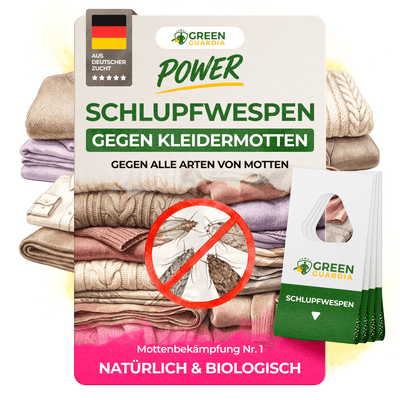
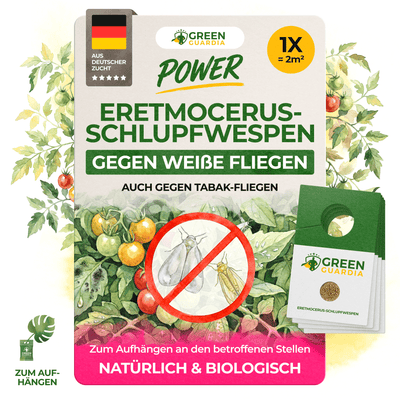
Green Guardia Eretmocerus parasitic wasps
A suitable choice for a confirmed tobacco whitefly infestation and appropriate application conditions, especially in warm, protected plant stands.
- Target pest: Bemisia tabaci; also usable against the greenhouse whitefly.
- Target stages: suitable larvae on the undersides of leaves.
- Application: Distribute carrier cards according to product instructions.
- Selection: Adjust quantity and repetitions to plant stand and infestation.
Why are these beneficial insects a good match?
The females lay their eggs under suitable host larvae. The hatching beneficial larva then penetrates the pest and develops at its expense.
Thus, treatment targets the growing generation of pests. Eretmocerus is also particularly interesting for warmer conditions.
What benefits does their use offer?
- Matching antagonist: Eretmocerus eremicus is used specifically against Bemisia tabaci.
- In the right place: The parasitic wasps search for host larvae on the leaves.
- Practical application: The beneficial insects hatch from the distributed carrier cards.
Buying guide: Is Eretmocerus right for your plants?
| Question | Why important? |
|---|---|
| Has the pest species been identified? | Not every whitefly belongs to the same species. |
| Are suitable larvae present? | Parasitization targets suitable immature stages. |
| Do temperature and light match? | Climate influences activity and development. |
| Were other products used? | Residues can affect beneficial insects. |
| How dense and heavily infested is the plant stand? | Area alone does not fully describe the requirement. |
Choose the variant according to the current product instructions. Additionally, take plant density and infestation severity into account. In case of heavy or unclear infestation, it is worth coordinating before ordering.
Applying Eretmocerus parasitic wasps correctly
- Prepare application: Check infestation, climate, and compatibility of other measures.
- Apply promptly: Observe delivery and storage instructions for the living beneficial insects.
- Distribute cards: Hang up in suitable places within the plant stand according to instructions.
- Protect cards: Do not spray directly and avoid direct sunlight.
- Continue checks: Check the undersides of leaves and adhere to recommended repetitions.
Do not use blanket waiting periods for all plant protection products. Compatibility depends on the specific product, application, and its residues.
Monitoring treatment success and preventing issues
Mark control plants and repeatedly examine comparable leaf areas. Keep track of new larvae, adult insects, and plant development.
Parasitization by Eretmocerus is not always clearly recognizable by dark discoloration. A lack of black coloration therefore does not automatically mean that the treatment was unsuccessful.
Additional measures
- Check new plants before integrating them.
- Keep suspicious plants separate if possible.
- Protect potentially parasitized leaves after release.
- Use yellow sticky traps only as a supplement for observation.
- Do not place sticky areas directly next to beneficial insect cards.
Frequently asked questions about the tobacco whitefly
Is the tobacco whitefly a whitefly?
Yes. This refers to the tobacco whitefly Bemisia tabaci, also known as the sweetpotato whitefly.
Why does Green Guardia recommend Eretmocerus?
Eretmocerus eremicus parasitizes suitable larvae of Bemisia tabaci and is particularly interesting for warm application conditions.
Do the parasitic wasps also combat adult tobacco whiteflies?
Parasitization targets larvae. Adult pests therefore do not disappear immediately after release.
How many cards should I order?
Refer to the current product instructions and take plant stand and infestation severity into account. If in doubt, coordinate requirements in advance.
Can I use plant protection products at the same time?
Only after checking specific compatibility. Already existing residues can also affect the use of beneficial insects.
Are yellow sticky traps alone sufficient?
They help with observation and trapping, but do not reach the stationary larvae. Suitable beneficial insects are useful for combating them.
Why do I not see any black larvae?
Eretmocerus does not cause the same noticeable discoloration as Encarsia does with the greenhouse whitefly. Therefore, evaluate the overall development of the infestation.
Can the tobacco whitefly reappear?
Yes. Overlooked stages or newly introduced plants can cause renewed infestation. Checks remain important even after successful treatment.