





















































How I finally found peace after a 3-month moth war without a single spray
My honest review: Why sticky traps actually prolonged the infestation and how 0.4 mm tiny helpers ended the problem forever in 9 weeks.

It started with a grey moth over the muesli.
My son was five, it was a Tuesday morning, and I was just pouring oat milk into his bowl. Suddenly, something small and grey fluttered past my face. I thought it was a fly. An hour later, while cleaning up, I saw a second one. Then a third. And then I opened the muesli package.
They weren't flies.
The package was crawling. Tiny, light-colored larvae. Silken cocoons in the corners. I can't describe how I felt—a mix of disgust, shame, and the question of how long this had been going on. And above all: what had my son been eating?
I threw away half my pantry that day. Flour, nuts, rice, even the unopened chocolate. Everything in the trash. And then, like probably anyone reading this, I did one thing: I searched online for "how to get rid of pantry moths."
What I did over the next 3 months and why none of it worked.
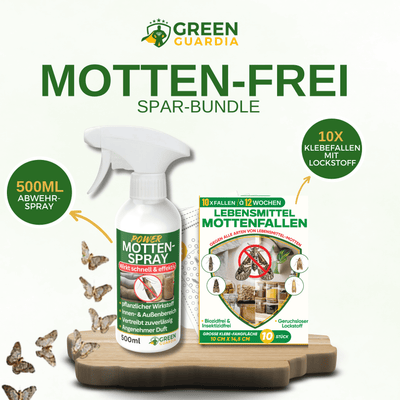
Pheromone traps. That was the first tip. Those little sticky boards that attract male moths. I bought four of them and hung them in every cupboard. Indeed, a dozen moths got stuck within two days. I thought I had won.
I hadn't.
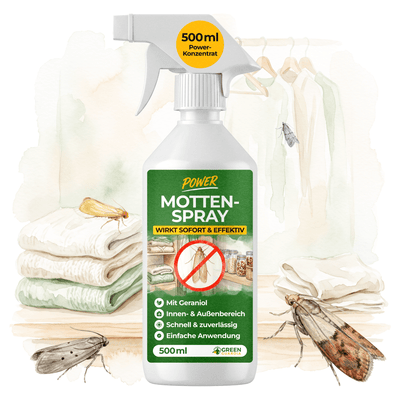
Three weeks later, new moths were fluttering through the kitchen again. I bought moth sprays, those chemical things containing pyrethroids. But when I looked at the packaging and read the safety warnings ("Do not use in areas where food is stored"), I put it back on the shelf. I’m not spraying insecticides next to my child’s breakfast.
Lavender sachets. Cedarwood. Bay leaves. Vinegar water. Tried it all. Everything a little. Nothing properly.
After three months, the infestation wasn't gone. It was just... less. But every day I still found one moth. And I knew: as long as one is alive, it continues.

Then I made a mistake that turned out to be the solution.
I was in a forum for young parents and asked for tips. One woman wrote: "Have you tried trichogramma wasps?"
Trichogramma wasps. I had to laugh. "Put more insects in my kitchen? Are you crazy?"
But she wasn't the only one. Three other parents recommended the same thing. I googled it, found greenguardia.de, and started reading. And the more I understood, the more it made sense.
Here is what no one explains about moth traps.
Pheromone traps only catch the male moths. That’s good for statistics—you see something hanging there and think it’s working. But: a moth population in your cupboard isn't maintained by males, but by eggs.
A single female pantry moth lays up to 300 eggs. Before she even goes near your trap, if she does at all. And those very eggs, small as pinheads, sit in the cracks of the cupboards, in the folds of the packaging, in corners you will never find with the naked eye.
That is the real reason why 70% of all moth treatments fail: you treat what you see. The eggs are quietly producing the next generation.
How trichogramma wasps turn this around.
Trichogramma wasps, scientifically known as Trichogramma evanescens, are a tiny 0.3 to 0.4 millimeters in size. They are not wasps in the traditional sense. They do not sting. They do not fly in the way you might expect (they only crawl). They have no interest in your food, your clothes, or you.
They are interested in exactly one thing: moth eggs.
What they do is fascinating and a little macabre: a female Trichogramma wasp searches for a moth egg, pierces the shell with her ovipositor, and lays her own egg inside. Over the next few days, it is not a moth that hatches, but a new Trichogramma wasp. The moth's life cycle is broken at the root.
Once there are no more moth eggs left, the wasps die off. They disintegrate into household dust without a trace. You will never see them, hear them, or notice them, except for the fact that the moths are gone.
The German Environment Agency has tested this method: it is completely harmless to humans, children, and pets. No chemicals. No residues. No poison in your cupboard.

What happened when I tried it.
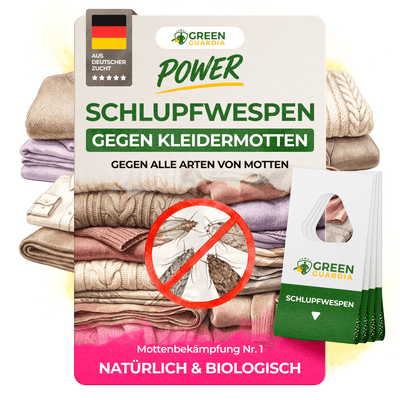
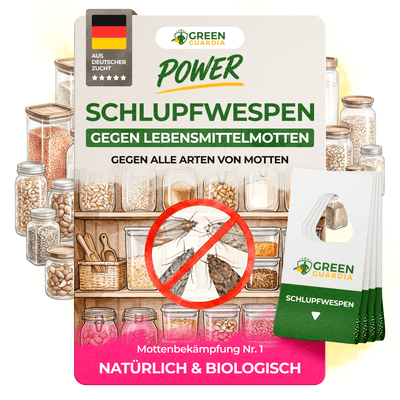
I ordered the trichogramma wasp set from Green Guardia. Three deliveries at 3-week intervals, because moths hatch in multiple generations and the entire cycle must be covered.
The cards arrived by mail. On each card: thousands of parasitized moth eggs from which the wasps gradually hatch. I placed one card in each cupboard, where the moths were most active. That’s all I had to do.

After 3 weeks: significantly fewer moths. After 6 weeks: I saw two more. After 9 weeks—three deliveries, applied as instructed—it was quiet.
Complete. Quiet.
That was 14 months ago now. Not a single moth since. In the meantime, I’ve also used trichogramma wasps preventively in my closet against clothes moths, because I’m never going to let anything eat one of my sweaters again.

GREEN GUARDIA GERMANY'S NO. 1 FOR BENEFICIAL INSECTS
- 450,000+ customers
- 11,362 reviews
- 100% organic
- Free shipping from 29 EUR
- Live arrival guarantee
- Support for delivery issues
Why I don't have any moth traps in my house anymore today.
If I had to tell someone with a moth problem something today, it would be this:
Pheromone traps are an early warning system, not a solution. Keep one in the cupboard as a sensor. If nothing gets stuck in it anymore, you know that the Trichogramma wasps have done their job.
Sprays are a last resort with side effects in living spaces, especially near food and children, that I personally would never accept again.
Trichogramma wasps have been the standard in professional storage for decades. Bakeries, flour mills, food manufacturers—they all use Trichogramma. It’s not just an idea for amateur gardeners. It is the most reliable method there is. It just hasn’t reached the mainstream yet.
I simply had never heard of it before. You are probably in the same boat.
What you can do now.
If you are currently struggling with pantry moths or clothes moths yourself and have had enough of sprays, sticky traps, and futile home remedies, give the trichogramma wasps a chance.
Green Guardia is the largest German address for biological pest control. 450,000 customers have already used them. Over 11,000 reviews—and yes, I wrote mine too. The standard set for pantry moths includes three deliveries, covers a complete moth cycle, and comes with clear instructions.
It’s not magic. It’s biology. But it is the only method I know that solves the problem at the root, without exposing your family to anything I wouldn't drink myself.
READY FOR A MOTH-FREE HOME?
The complete trichogramma wasp set for pantry moths:
- 3 deliveries at 3-week intervals
- Covers a complete moth cycle
- Up to 9,000 trichogramma wasps per delivery
- 100% biological, confirmed harmless by the Federal Environment Agency
- Free shipping
- Live arrival guarantee
Note: This review reflects an individual customer experience. The effectiveness of biological pest control can vary depending on the severity of the infestation and application. According to the Federal Environment Agency, trichogramma wasps are harmless to humans and pets. Anna L. is a Green Guardia customer; this article has been editorially prepared.
